On this page5
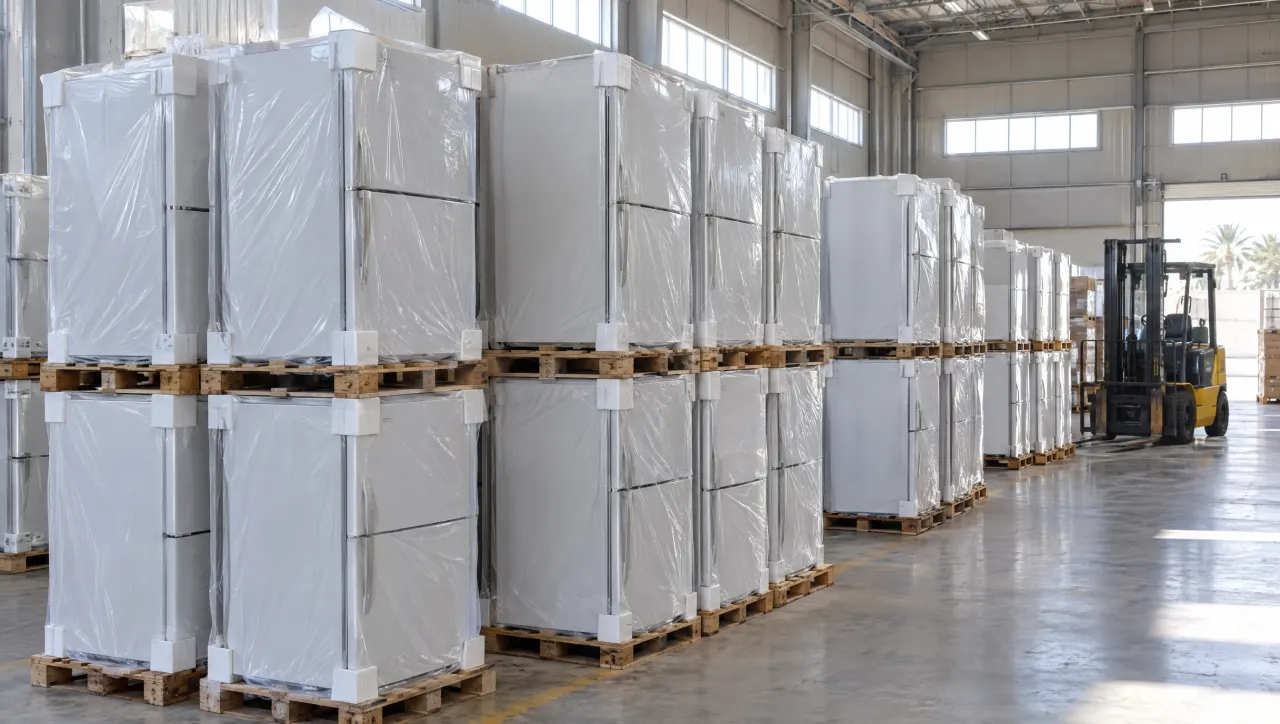
A refrigerator travels a long way before it reaches a kitchen: from the factory to the port, across the sea in a container, through a warehouse in the Gulf and on to a shop. On that route it meets dust, strong sun, humid port air and many forklifts. A stretch hood covers each appliance, or each pallet of appliances, in one tight film that closes on five sides.
What a stretch hood does to a refrigerator
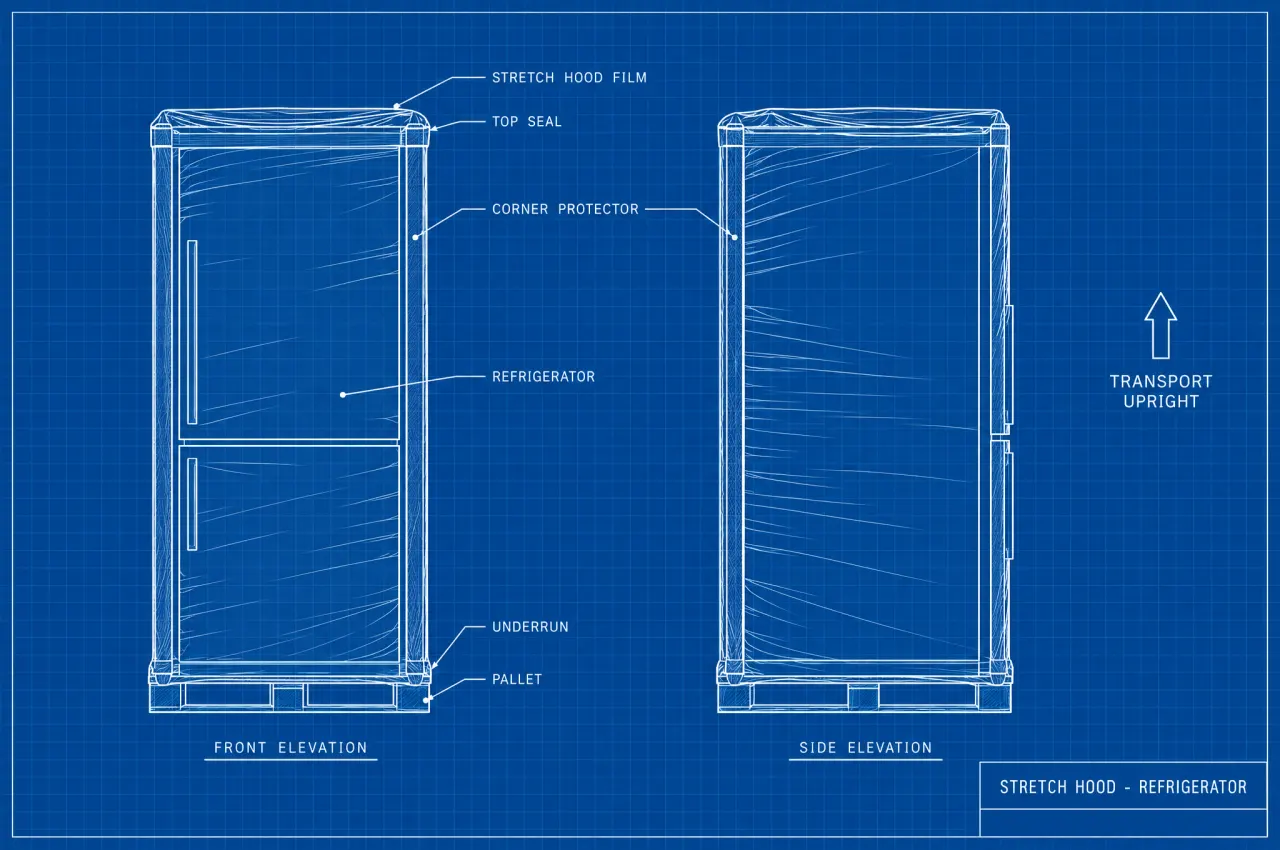
The stretch hood machine cuts a tube of film to the height of the load, seals the top, stretches the open hood wider than the appliance with four arms and pulls it down. When the arms let go, the film contracts by itself and holds the refrigerator from all four sides and the top. No heat is used at any point.
- Five closed sides: the top and all four walls are covered, so the pack is essentially water- and dust-proof, unlike a spiral stretch wrap.
- Clear film: the model, the brand and the barcode stay visible and scannable.
- No heat: unlike a shrink hood, no gas burner or heat tunnel comes near the appliance, its plastic parts or its door seals, and there is no fire risk on the line.
- One layer: one fitted hood replaces several turns of wrap or a full cardboard case on many lines.
Why it suits the UAE and Saudi Arabia
- Sun and heat: UV-stabilised stretch hood films are made for months of outdoor storage; suppliers quote lifetimes of about 6 to 24 months outdoors, depending on the film.
- Sand and dust: the closed top and sides keep fine dust out of door gaps, hinges and the compressor area during storage at ports and in open yards.
- Humid ports: a closed hood keeps rain and spray off; for long storage in humid coastal areas, ask for a film made to limit condensation and keep hooded appliances out of direct sun.
- Raw material from the region: the polyethylene grades used for stretch hood film are produced in the Gulf, for example metallocene LLDPE grades by SABIC in Saudi Arabia and Borouge in the UAE.
Handling refrigerators correctly
A stretch hood holds the appliance, but the appliance still needs the right handling. Refrigerators should travel upright: the compressor oil must stay in the compressor. Appliance makers advise waiting a few hours before switching on a refrigerator that travelled upright, and up to a day if it was laid down. Corner protectors under the hood spread the clamping force of the film and protect the edges from forklift and strap contact.
Questions buyers ask
Can each refrigerator get its own hood?
Yes. Stretch hooding is used both for single appliances and for full pallets; the film size is chosen for the appliance or the load.
Does stretch hood replace the cardboard box?
On many appliance lines a stretch hood with corner protectors replaces the full carton; whether it suits your products and your customers depends on the route and the handling.
Which film do we need for outdoor storage in the Gulf?
A UV-stabilised stretch hood film. Tell us how long the goods stand outside and we match the film to it.
Sources
- Section
- Stretch hood packaging
- Reading time
- 3 min read
Discuss this with our team
Tell us what you need and our team replies by email.
Send an enquiry